

Material Point Method Modeling for Geomechanics in 2D
Accurately simulate large deformation, failure progression, and material movement in geotechnical systems with MPoint2D’s high-fidelity Material Point Method technology.

MPoint2D
Contact for pricing
What is MPoint
MPoint2D is a specialized two-dimensional Material Point Method application for geotechnical numerical modeling. It’s built for engineers who need to simulate large deformation, instability, and post-failure movement in problems where conventional methods can struggle to remain accurate. MPoint2D pushes numerical modeling beyond the geometric limitations of mesh-based methods.
MPoint2D provides a practical environment for evaluating how soil, rock, water, and mixed ground systems respond under realistic loading, construction, and boundary conditions. From concept screening to detailed failure assessment, it helps engineers understand not just whether a system is stable, but how it deforms, mobilizes, and fails.
What You Can Achieve With MPoint
Master Large Deformation
Simulate extreme deformation, material flow, and failure progression without mesh distortion or remeshing limitations.
Capture Real-World Failure Mechanisms
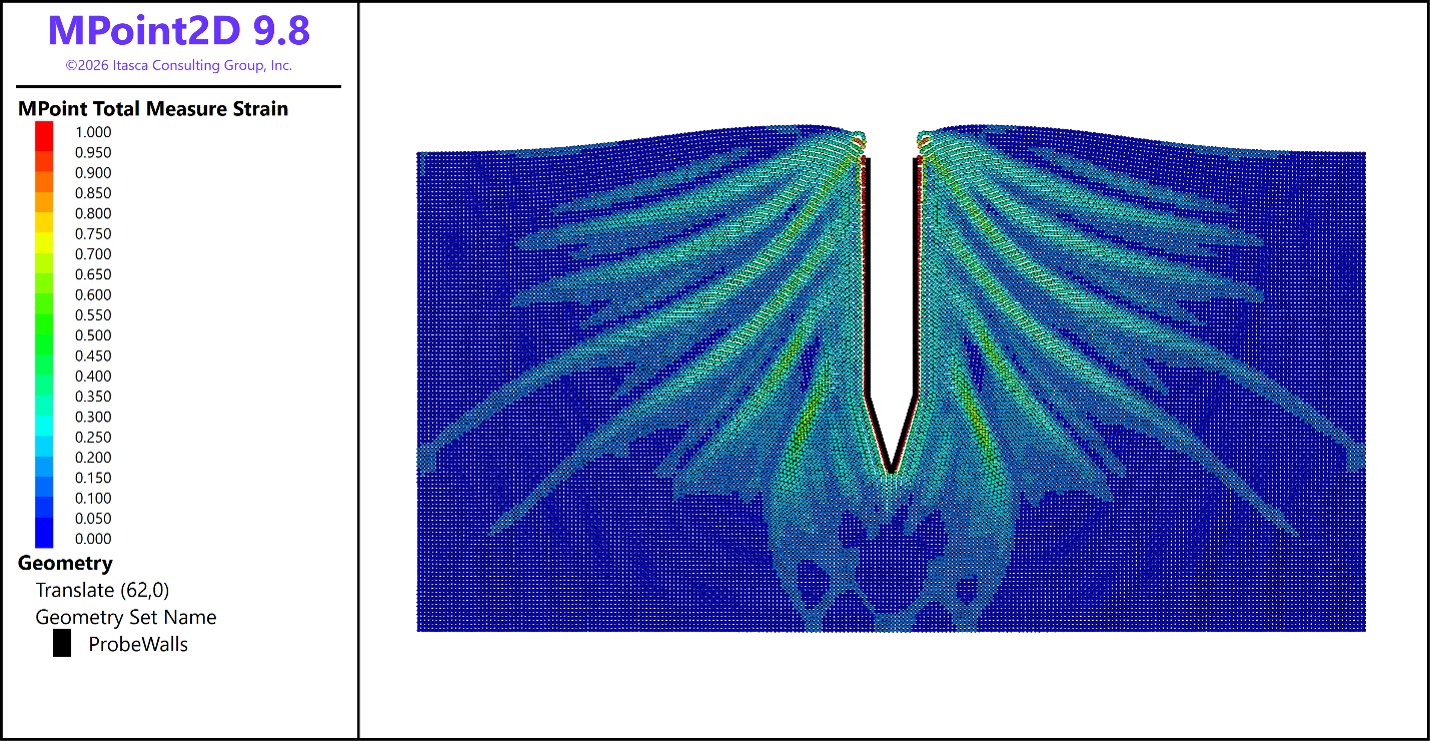
Model localized shear banding, progressive failure, liquefaction, slumping, breach initiation, and runout as they develop.
Analyze Complex Ground Systems
Simulate interactions between soil, rock, water, and other geotechnical materials in a single modeling framework.
Why Choose MPoint?
MPoint2D is designed for geotechnical scenarios where the key engineering question is not just equilibrium, but post-instability behavior. For tailings dams, earthen dams, slopes, embankments, and foundation failures, Material Point Method modeling provides a clearer view of deformation and collapse mechanisms than approaches that rely on small-strain assumptions or idealized failure surfaces.
With MPoint2D, engineers can evaluate scenarios that involve staged construction, pore pressure changes, liquefaction triggering, and runout prediction through a formulation that is better aligned with the physics of large movement. That means more defensible results, stronger design insight, and better decision-making for high-consequence ground engineering problems.

Designed for Large Deformation
Analyze problems involving significant movement, deformation, and material flow without the mesh distortion and remeshing challenges common to traditional numerical methods.

Fast, Focused Analysis
Built specifically for 2D engineering problems, MPoint2D eliminates the complexity of full 3D modeling, helping you build, test, and refine models faster while maintaining confidence in results.

Reliable, Defensible Results
Use Material Point Method modeling to capture realistic deformation and failure behavior in soils, rock, water, and mixed geotechnical materials.

Seamless Coupling with FLAC2D
Couple MPoint2D with FLAC2D to efficiently model the large-deformation zone with MPM while using FLAC2D for the surrounding continuum response.
Built for Geotechnical Practitioners
MPoint2D is designed for engineers and researchers working with deformation, pore pressure, stability, and failure—not generic MPM workflows.
Who it’s for
- Geotechnical engineers analyzing tailings dams, slopes, embankments, and foundations under large deformation.
- Mining engineers evaluating tailings storage facilities, staged construction, and liquefaction risk.
- Civil and infrastructure teams assessing embankment performance, failure progression, and runout.
- Energy and environmental engineers modeling containment systems and long-term ground response.
- Researchers developing constitutive models, large-deformation methods, and continuum-MPM coupling approaches.
Typical workflow
- Build or import geometry, material models, and initial stress conditions.
- Define staged construction, loading, and pore pressure conditions (may require coupling with FLAC2D).
- Run large-deformation simulations to capture material movement, stability loss, and failure progression.
- Post-process deformation, pore pressure, stress paths, and runout to inform design and risk assessment.
What Makes MPoint Different
For geotechnical engineers working on tailings dams, earthen dams, and slopes, the difference is clear: MPoint2D is built for large-deformation ground behavior where the foremost issue is not only stability, but what happens after stability is lost.
| Aspect | MPoint | Anura (general purpose MPM tool) |
|---|---|---|
| Primary Focus | Geotechnical and mining applications like tailings dams, water / rockfill / earthen dams, roadway cuts and embankments, and large‑deformation slope failures. | General MPM framework for solids / fluids and multiphysics; not targeted specifically for dam and slope engineering workflows. |
| Static liquefaction & flow slides | Designed to analyze contractive tailings and loose soils, from triggering of static liquefaction through post‑failure flow and runout for tailings and embankments. | Can represent liquefaction and flow behavior but specific failure modes and design checks must be assembled largely by the user. |
| Constitutive models for tailings & soils | Emphasizes soil and tailings behavior (contractive / dilative response, shear banding, interfaces, weak layers) as encountered in real dam and slope projects. | General material models. Tailored rock or soil behavior and layered geotechnical profiles require client development. |
| How quickly can I start a project? | Immediate start with GUI, solvers, and workflows ready out of the box. | Requires environment setup, UI development, and often code modification before modeling begins. |
| Integration with FEM tools (e.g., FLAC3D) | Native coupling with FLAC2D for seamless hybrid modeling of small and large deformation physics. | No native coupling. Custom integration required. |
MPoint2D Options
Expand your MPoint2D capabilities with add-on options designed to tackle diverse engineering challenges effectively.
Dynamics
Enhance simulations with dynamic analysis for earthquake engineering, soil liquefaction, and more. Includes robust boundary conditions and fast model run times.
- Customizable boundary conditions (acceleration, velocity, stress waves)
- Soil-structure interaction and thermal coupling
- Dynamics Wizard for pre-processing
- Maxwell damping for fast simulations
- Multiple dynamic and liquefaction constitutive models
Learn more
Resources
Explore the resource library to learn more about the benefits and capabilities of MPoint and the Material Point Method. Read case studies and blog articles detailing how MPoint can tackle geotechnical challenges with precision and innovation.



Selected by World-Class Organizations


Hear from Satisfied Users
Integration with Other ITASCA Tools
MPoint2D integrates with FLAC2D to create an efficient hybrid modeling approach that combines Material Point and Finite Difference methods. It captures large deformation and localized failure with high accuracy while efficiently representing the surrounding ground response—delivering reliable results with reduced computational cost for complex geotechnical analyses.
Benefits of Coupling MPoint2D and FLAC2D
- Integrated modeling of complex systems – Coupling the Material Point and Finite Difference Methods enables efficient analysis of problems that require both large-deformation mechanics and far-field ground response.
- Seamless interaction between domains – Stresses and displacements are exchanged directly, allowing local material movement to influence the broader system response.
- Method-specific modeling – Each numerical method is applied where it performs best: MPoint2D for large deformations and FLAC2D for continuum modeling.
Software Support and Education Hub
We’re here to help you maximize the potential of ITASCA software and tackle any geotechnical challenge with confidence. Explore the resources below to get started.


Common Questions from Teams like Yours
Answer: MPoint2D is designed for geotechnical and civil engineering problems involving large deformation, material movement, and complex soil behavior that can be effectively represented in two dimensions.
Typical applications include:
- Slope instability, landslides, and progressive failure analysis
- Excavation and earth retention systems
- Foundations, embankments, and levees
- Earth dams and tailings storage facilities
- Tunnel and underground excavation cross-sections
- Soil-structure interaction problems
- Construction staging and excavation sequencing
- Runout and post-failure deformation studies
Unlike traditional finite element approaches, MPoint2D uses the Material Point Method to accurately capture large deformations, material flow, and evolving failure mechanisms without mesh distortion. This makes it particularly valuable for problems where conventional methods can struggle to maintain numerical stability or realism.
Answer: MPoint2D uses the Material Point Method to capture large deformation and post-failure behavior without the mesh distortion that can limit traditional approaches. Maintaining mesh integrity is especially valuable for cases where progressive movement, liquefaction, and collapse drive the engineering outcome.
Answer: Typical inputs include geometry, material properties, boundary conditions, and loading or construction sequencing. MPoint2D is built to handle evolving geometry and large-strain response throughout the simulation.
Answer: MPoint2D is designed to deliver advanced numerical modeling capabilities without requiring specialized hardware.
Typical requirements include:
- Operating System: Windows 10 or Windows 11 (64-bit)
- Processor: Modern multi-core CPU
- Memory: 8–16 GB RAM for standard projects; additional memory recommended for large or highly refined models
- Storage: Several gigabytes of available disk space
- Graphics: Modern OpenGL-compatible graphics hardware for efficient visualization
Compared to many full-scale 3D numerical simulations, 2D MPM analyses generally require less computational power while still providing valuable insight into complex geotechnical behavior. This allows engineers to perform rapid design iterations and sensitivity studies on standard engineering workstations.
Answer:
GeoBot AI Assistant
Getting started with MPoint2D is easier than ever with GeoBot, ITASCA’s free AI-powered assistant for geotechnical modeling. GeoBot provides on-demand support to help users learn, build, and troubleshoot MPoint2D models faster. With GeoBot, users can:
- Generate and explain MPoint2D commands and scripts
- Access product documentation through natural language questions
- Find relevant example models and tutorials
- Receive guidance on model setup, material properties, and boundary conditions
- Learn best practices for MPM modeling and interpretation of results
- Troubleshoot common modeling and workflow issues
Documentation and Examples
MPoint2D includes comprehensive documentation and a library of example projects covering common geotechnical applications such as:
- Slope stability and landslides
- Excavations and retaining structures
- Embankments and levees
- Foundations and soil-structure interaction
- Large-deformation and post-failure analyses
Expert Support
For advanced applications, users can leverage ITASCA’s global team of geotechnical and numerical modeling experts through technical support, training programs, and consulting services.
Answer: Yes. MPoint2D can be coupled with FLAC2D to combine large-deformation MPM modeling with finite-difference continuum response.
Ready for the Next Steps?
Explore our MPoint licensing options & pricing plans
Find the Right Solution for your Modeling Challenge
If you’re exploring the best solution for your project, you can find the right software, talk with an expert, request a tailored quote, or download a free demo to try MPoint firsthand.