
Optimize Your Mining Operations
Achieve efficiency and safety with ITASCA’s mining software solutions

Mining Engineering Software Solutions
At ITASCA, we provide state-of-the-art numerical modeling software designed to address the most complex geomechanical and stability challenges in mining engineering. Our comprehensive suite of software (IMAT, FLAC2D, FLAC3D, MassFlow, PFC, and 3DEC) empowers engineers to design safe, efficient, and cost-effective mine solutions. ITASCA offers solutions for every mining challenge to reduce risk and optimize production.
Key Challenges & Our Solutions
Find the right ITASCA software for your specific mining challenge. Click on each section below to learn more about how we can help you solve industry-specific problems.
Optimize and adjust designs throughout the mine lifecycle.

Mining Method Evaluation
ITASCA Software provides detailed models of your mining operations to evaluate methods and sequences suited to the orebody geometry, in-situ stress, and rock mass strength conditions. Different mining methods (room-and-pillar, long-hole stoping, cut-and-fill, solution stoping, and longwall mining) can be effectively assessed with our tools. Calibrate models with new data as it becomes available over the course of the life of mine to revise mining plans.

Excavation and Pillar Design
Evaluate and design pillar, room, stope, and panel dimensions with FLAC3D and 3DEC. ITASCA software is particularly adept at resolving the stress-strain response of massive, blocky, and bedded rock exhibiting plastic, brittle, and creep behaviors over all scales of mining.

Backfill Design
Use FLAC3D to optimize backfill strength to minimize costs while ensuring stability. Appropriate backfill strength is crucial in operations such as underhand mining and sublevel stoping with primary and secondary stopes. ITASCA software is capable of dynamic modeling to examine stability under dynamic rockburst conditions, as well as instrumentation and testing of placed backfill, bulkheads, and sill mats made of cemented backfill.

Infrastructure Design
Robust designs for critical infrastructure like access, production and ventilation shafts, ramps, crusher stations, and haulage drifts are essential to ensure long-term stability for mine viability and safety of personnel. Analyze design considerations that impact long-term stability of future adjacent excavations and infrastructure development, such as in-situ and mining-induced stress, geologic structures, and other intersecting developments. A plethora of characteristics can be modeled and assessed with ITASCA software.
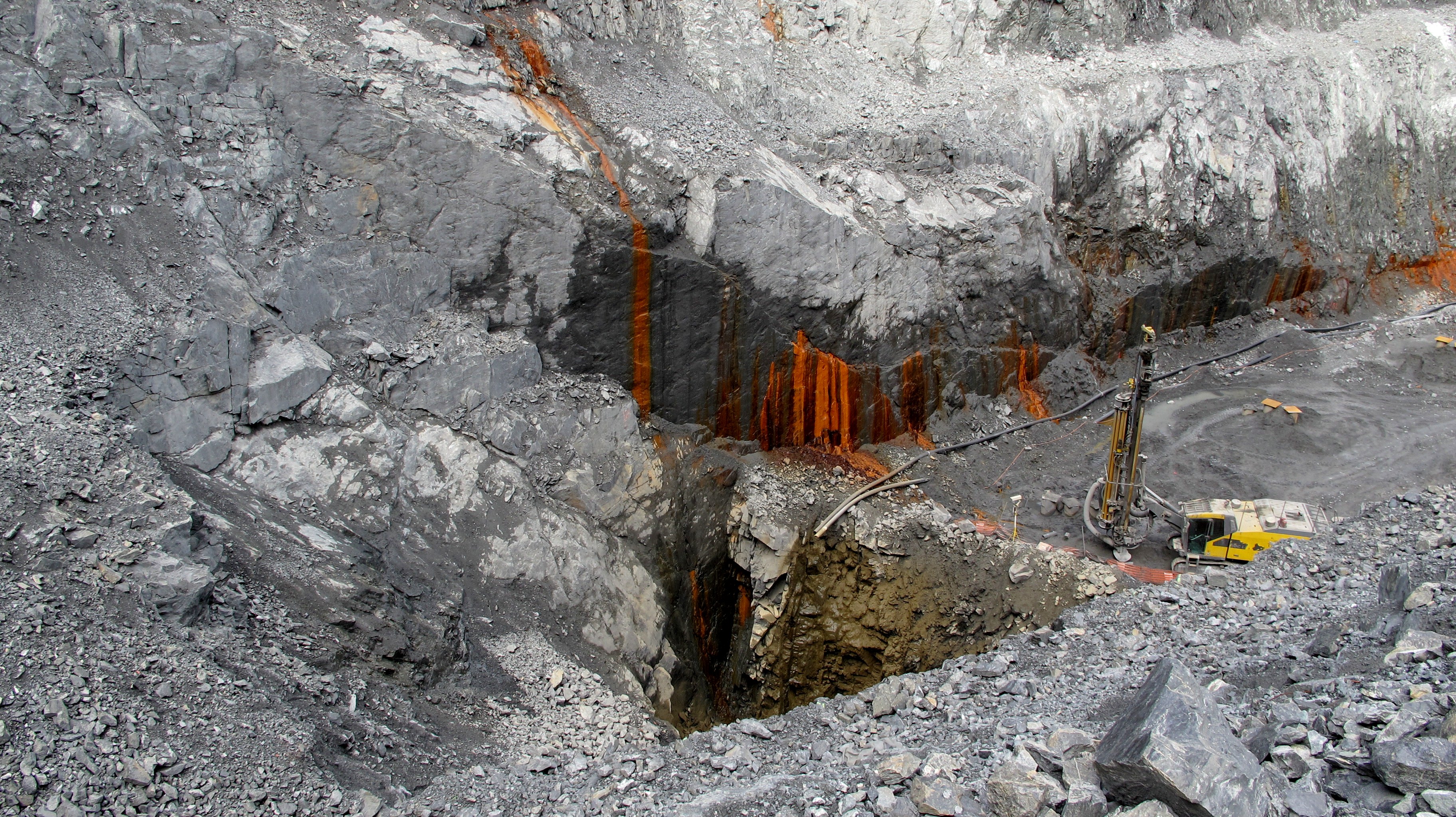
Underground and Open Pit Interaction
FLAC3D, 3DEC, and IMAT models can be used to replicate the macro behavior observed on site to better understand underlying mechanisms. Through calibration and validation, these numerical models can be used for forecasting purposes. The combination of Synthetic Rock Mass (SRM) modeling and microseismic analyses provides a preliminary assessment of potential volumes of rock failure during caving operations prior to production start-up.
Model mine designs to prevent instability and subsidence.

Slope Stability & Design
Use ITASCA software (FLAC2D, FLAC3D, 3DEC, PFC) to accurately assess slope stability and design pit slopes on bench, inter-ramp, and global mine scales for open pits, waste dumps, leach piles, and tailings dams. Predict behavior under various loading conditions and calculate the factor of safety for any slope configuration and view potential failure mechanisms.

Instabilities & Remediation
Determine safety factors using products suited to the challenges of your operation: FLAC2D or FLAC3D for soil or highly fractured rock slopes, and UDEC and 3DEC for slope assessments where intersecting geologic structures impact slope movements.

Ground Support Design
Design the ground support layout and specification necessary to reinforce, retain, and hold the rock mass around excavations by using a combination of engineering tools such as Ground Reaction Curves and practical numerical modeling tools based on instrumentation data. Ground support elements like rockbolts, cables, and liners are integral components of ITASCA software.
Optimize mining sequences in caving operations.

Caveability
The ability to forecast cave propagation by understanding the evolving size and shape of seismogenic, yielded, and mobilized zones associated with caving is critical to mine design. This establishes critical hydraulic radius and the potential for hang-ups and air gap formation, which is important to understand likely cave propagation rates and to define cave limits.
Infrastructure Stability
Understanding the redistribution of stresses associated with caving plays a role in assessing the stability and ground support effectiveness of undercut and extraction-level development and other critical infrastructure in both high- and low-stress environments.

Fragmentation
Discrete Fracture Networks (DFNs) can be embedded within PFC3D or 3DEC models of intact rock and strained to simulate the primary fragmentation process as a function of expected cave back stresses. Then input the primary fragmentation measurements in MassFlow to predict the flow and drawdown from hundreds of drawpoints over the life of mine. Using a user-defined drawpoint layout and production schedule, secondary fragmentation can be predicted, with blocks breaking down in the column as a function of stress and strain and the rock block strength.

Draw Control, Flow, & Recovery
Draw strategy is key to maximizing recovery, minimizing dilution, and managing hazards like hang-ups and mud rush. Simulate how material flows within a cave with MassFlow to inform the design stage (drawpoint spacing, drawpoint layout, drawbell geometry) and operation (draw rates, draw ramp-up and scheduling). The fragmentation exiting drawpoints can be estimated over time to establish likely drawpoint availability and secondary breakage requirements.

Subsidence
Evaluate mining-induced subsidence related to the extraction of ore from both underground and open pit mines, as well as dewatering-induced subsidence. Predict the magnitude and extent of subsidence related to a particular mine design to optimize the location of infrastructure and understand any impacts on existing property and the surface environment.
Model rock mass behavior and monitoring data.

Rock Mechanics and Deformation Monitoring
Simulate rock mass behavior under various stress conditions with FLAC3D, PFC, and 3DEC to model rock deformation and evaluate stress distribution, aiding in the planning of mitigation measures. Monitored ground movements from various sources, such as prism data, can be imported into ITASCA software to directly compare with simulated results, aiding in the calibration process and back analysis of observed behavior.

Model and predict mine groundwater conditions.

Groundwater Analysis
Model groundwater inflow to mine workings to determine pumping and handling requirements and pore-pressure distributions to assess underground infrastructure and slope stability. Predict moisture content to evaluate mud-rush potential and water quality to meet regulatory requirements. Use FLAC3D for simple groundwater models or MINEDW for complex mining-related groundwater conditions, like enhanced permeability around the mine and over the life of the mine. Calculated pore pressures from MINEDW can then be imported seamlessly into other ITASCA software for use in geomechanical stability analyses.

Dewatering
Estimate the dewatering needs of a mine to temporarily lower groundwater levels below the natural groundwater level, in all seasons. Design and optimize the dewatering and water-disposal systems, drain holes, and monitoring wells to provide a safe working environment during operations.

Environmental Assessment
Assess environmental impacts to the quantity and quality of water resources for environmental permitting and regulatory compliance during operation or to develop exit strategies for site closure.
Find solutions for specialized applications.

Dynamic and Blast Analysis
ITASCA software can be used to understand blasthole-to-blasthole interaction, optimize fragmentation and throw, and minimize undesirable damage. FLAC3D and PFC can model blast-induced vibrations and evaluate structural integrity to analyze the effects of blasting on mine stability and structural integrity.

Solution Mining
Modeling of solution mining requires analysis of the key processes controlling mineral dissolution, and numerous factors can complicate that process. With ITASCA software and a robust dataset, evaluate potential solution mining scenarios to assess potential ore recovery, capital costs, and cavern lifetimes to optimize proposed mine plans.

Mining Engineering Use Cases of ITASCA Software
See how our software addresses unique challenges across mining sectors.

Underground Mining
Model underground mining operations with IMAT or FLAC3D to simulate complex geomechanical behavior, assess stope stability, and optimize extraction sequencing for safer and more efficient resource recovery.


Who Benefits from ITASCA Software?

Engineers
Model complex geological conditions, mechanical behavior of rock, and mining sequences with software powered by efficient solvers and multi-threaded processing to reduce computation time, allowing for more iterations and model refinement to meet tight project schedules.
Decision Makers
Access significant cost savings by preventing overdesign and costly production errors through geomechanical analysis. Predictive modeling with ITASCA software can identify potential failure modes and factors of safety of various scenarios to create informed risk management strategies.
Researchers
Advanced simulation tools support high-level research into geomechanical engineering, rock mechanics, and structural interactions. ITASCA’s powerful software products provide a robust platform for validating and calibrating theoretical models against empirical data.
Success Stories with ITASCA Software
Discover the impact of ITASCA Software in mining projects through real-life case studies. Explore how our advanced geotechnical modeling solutions address complex challenges in the mining industry and deliver exceptional results with innovative approaches and significant achievements.

Numerical Assessment of Instability at Bajo de La Alumbrera Mine
Using 3DEC for back-analysis of failure, calibrating with field observations.

Simulating Slope Displacement using IMASS Modeling
Utilizing FLAC3D and IMASS model for back-analyzing slope displacement.

Caving Propagation Study for Esmeralda Block
Using 3DEC for back-analysis of failure, calibrating with field observations.

Blast Movement Simulation using Modeling and Machine Learning
Using FLAC3D, PFC, and machine learning to model the dynamic process of rock blasting.
Let’s start a conversation
At ITASCA, we are committed to providing advanced tools that empower engineers to solve the most complex mining engineering challenges. Explore our software solutions and see how they can enhance your geomechanical projects in mining.